
Posts

New paper: Assessing the visual image quality provided by refractive corrections during keratoconus progression
This works assesses the visual image quality of keratoconic eyes corrected by means of sphero-cylindrical spectacles and rigid contact lenses as keratoconus progresses. Overall, the results reflect the clinical experience that subjective refraction is challenging in highly-aberrated keratoconic eye…
New paper: Modeling refractive correction strategies in keratoconus
It is challenging to find the optimal spectacle correction for a keratoconic eye. To assess this problem in detail, the SyntEys KTC model was fitted all possible spherocylindrical corrections within the range of a phoropter, each time determining the visual image quality. This demonstrated that the…
New paper: Forecasting progressive trends in keratoconus by means of a time delay neural network
Early and accurate detection of keratoconus progression is particularly important for the prudent, cost-effective use of corneal cross-linking and proper timing of clinical follow-up visits. This study assesses whether keratoconus progression could be predicted based on two prior tomography measure…
New article: Determining the Most Suitable Tomography-Based Parameters to Describe Progression in Keratoconus
Not every corneal tomography parameter is equally suited to follow-up the progression of keratoconus. This work judges the parameters provided by the Pentacam by their repeatability in different degrees of the disease, consistency between patients, and monotonicity during progression to come to an …
New paper: Scheimpflug Densitometry in Keratoconus: A New Method of Visualizing the Cone
Marta Jiménez García recently discovered that manifest keratoconus often goes accompanied by a bright region in the corneal densitometry that extends over the entire depth of the cornea. This may be a new way to delineate the region affected by biomechanical weakening.Jiménez-García M, Ní Dhubhghai…

New article: Repeatability of the Pentacam HR in Various Grades of Keratoconus
To understand the relative importance of tomographic indices of the Pentacam in the follow-up of keratoconus, we looked at their repeatability for varying stages of the disease, as well as for normal eyes. Maximum anterior curvature, often used in keratoconus follow-up, has a variability larger tha…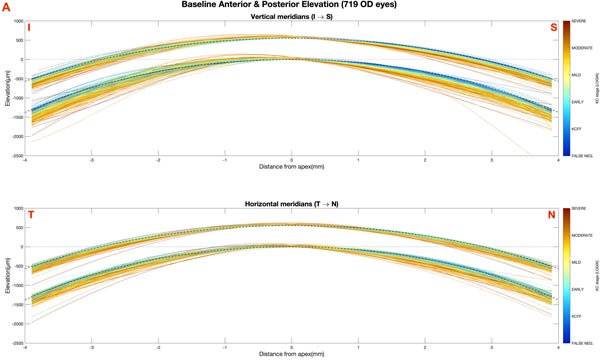
New article: Baseline findings in Retrospective Digital Computer Analysis of Keratoconus Evolution (REDCAKE) project
This work is the first of a series of papers to discuss the reults of the Retrospective Digital Computer Analysis of Keratoconus Evolution (REDCAKE), beginning with the baseline analysis for a large cohort of keratoconus patients. It looks at how the stage of the disease affects the cone curvature …
New article: Logistic index for keratoconus detection and severity scoring (Logik)
Knowing the stage of a keratoconic cornea is essential for progression follow-up and the choice of treatment. Proper staging can be challenging, however, since many of the available parameters are inadequate to the task (e.g. K_max and Pachy_min). This inspired us to develop the Logistic Index for…