
Posts

New paper: Emmetropization and nonmyopic eye growth
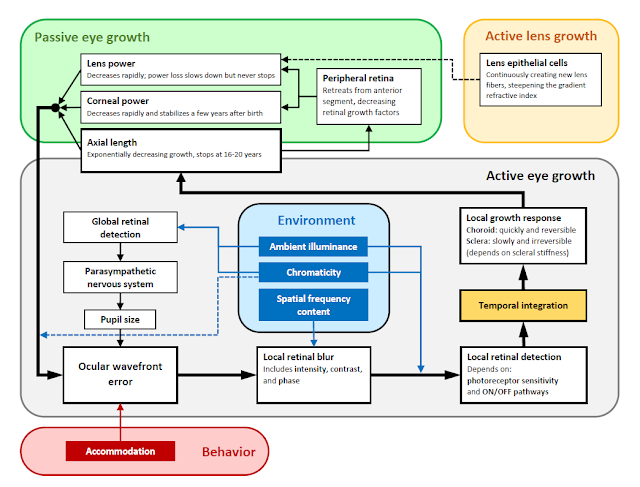
Early ocular growth is a complex developmental choreography performed by the components of the eye. Most eyes start with a hypermetropic refractive error at birth, but the growth rates of the ocular components, guided by visual cues, will slow in such a way that this refractive error decreases du…
New paper: Refractive development I: biometric changes during emmetropization
The eye undergoes many rapid changes during childhood, while maintaining a refractive error close to emmetropia during the whole process. This work uses the combined (averaged) data of 295 papers to derive regressions that describe ocular growth from before birth until adulthood. Rozema JJ. Refracti…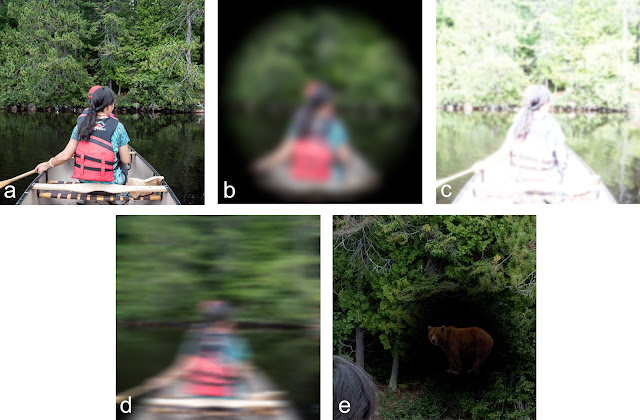
New paper: A deep look into animated eyes
We have been surrounded by animated characters all our lives. Aesthetically, the facial features of these characters tend to be simplified to allow conveying the same basic emotions easily portrayed by human actors. Eyes play a major role in these expressions, which consequently has led artists to …
New paper: Modeling refractive correction strategies in keratoconus
It is challenging to find the optimal spectacle correction for a keratoconic eye. To assess this problem in detail, the SyntEys KTC model was fitted all possible spherocylindrical corrections within the range of a phoropter, each time determining the visual image quality. This demonstrated that the…
New paper: Forecasting progressive trends in keratoconus by means of a time delay neural network
Early and accurate detection of keratoconus progression is particularly important for the prudent, cost-effective use of corneal cross-linking and proper timing of clinical follow-up visits. This study assesses whether keratoconus progression could be predicted based on two prior tomography measure…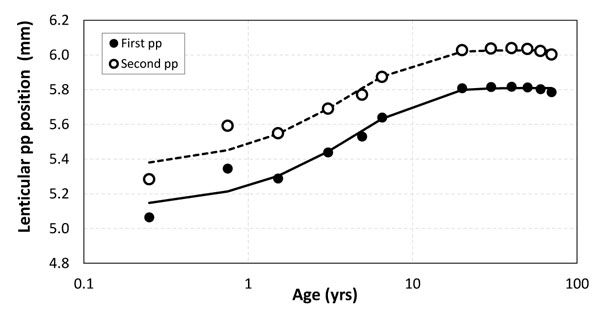
New article: Estimating principal plane positions for ocular power calculations in children and adults
As lens biometry is still difficult to obtain, authors may be inclined to make assumptions about the principal plane positions in the eye. The assumed values are usually based on the proportions of adult eye models, but these may be quite unsuitable for use in children's eyes. To this end, the …
New paper: Scheimpflug Densitometry in Keratoconus: A New Method of Visualizing the Cone
Marta Jiménez García recently discovered that manifest keratoconus often goes accompanied by a bright region in the corneal densitometry that extends over the entire depth of the cornea. This may be a new way to delineate the region affected by biomechanical weakening.Jiménez-García M, Ní Dhubhghai…

New paper: Age‐related axial length changes in adults: a review
Many cross-sectional studies on axial length reproted an age-related decrease that is physiologically difficult to explain. This analysis explores the possible origins of these observations and found that they are associated with gradual changes in increased body length and education level.Rozema J…

New article: Differences in ocular biometry between urban and rural children matched by refractive error: the Shandong Children Eye Study
Using the data from the Shandong Children Eye Study, we established that children living in the countryside and those living in cities have fundamentally different eye structure, despite having the exact same refraction. Mediation analysis demonstrated that this difference is associated with the w…
New article: Axial Growth and Lens Power Loss at Myopia Onset in Singaporean Children
This work studies the biometry changes before and after myopia onset in the Singapore Cohort Study of the Risk Factors for Myopia (SCORM). At myopia onset, the myopic shift increased to 0.50 diopters per year or more in new myopes compared to the minor changes in emmetropes of the same age. New m…
New article: The components of adult astigmatism and their age-related changes
Refractive astigmatism gradually changes from with-the-rule (WTR) towards against-the-rule (ATR) with age. This work studies the underlying corneal and internal changes using the refractive and corneal biometry data 1195 healthy Caucasian subjects, expressed in power vectors. The refractive power …
New article: Average biometry of the cornea in a large population of Iranian school children
This work establishes the average Scheimpflug corneal tomography for a population of 4953 healthy Iranian primary school children. These data were transformed to determine the corneal position and orientation in three-dimensional space, followed by a model fit that combines a biconic with a Zernik…
New article: In vivo anterior scleral morphometry, axial length and myopia
This work reports on the relatively strong correlations between anterior scleral morphometry and axial length, and consequently to the refractive state of the eye in myopes and emmetropes. The refractive state of each patient should therefore be taken into consideration when analysing scleral …
New paper: Scleral asymmetry as a potential predictor for scleral lens compression
This study shows that scleral asymmetry can be used as a parameter to predict scleral lens settling. Larger amounts of scleral asymmetry were found to lead to larger decentration in the impression of the lens on the ocular surface, as well as deeper compression of the sclera. Scleral asymmetry has…
New paper: Rotation asymmetry of the human sclera
In order to characterize the mean topographical shape of the human sclera of a normal eye forty-five participants aged 19 to 45 years were measured with a corneo-scleral topographer (Eye Surface Profiler). For each 3D map, the sclera (maximum diameter of 16 mm) and cornea were automatically separa…