
Posts

New paper: Assessing the visual image quality provided by refractive corrections during keratoconus progression
This works assesses the visual image quality of keratoconic eyes corrected by means of sphero-cylindrical spectacles and rigid contact lenses as keratoconus progresses. Overall, the results reflect the clinical experience that subjective refraction is challenging in highly-aberrated keratoconic eye…
New paper: Forecasting progressive trends in keratoconus by means of a time delay neural network
Early and accurate detection of keratoconus progression is particularly important for the prudent, cost-effective use of corneal cross-linking and proper timing of clinical follow-up visits. This study assesses whether keratoconus progression could be predicted based on two prior tomography measure…
New article: Determining the Most Suitable Tomography-Based Parameters to Describe Progression in Keratoconus
Not every corneal tomography parameter is equally suited to follow-up the progression of keratoconus. This work judges the parameters provided by the Pentacam by their repeatability in different degrees of the disease, consistency between patients, and monotonicity during progression to come to an …
New article: Repeatability of the Pentacam HR in Various Grades of Keratoconus
To understand the relative importance of tomographic indices of the Pentacam in the follow-up of keratoconus, we looked at their repeatability for varying stages of the disease, as well as for normal eyes. Maximum anterior curvature, often used in keratoconus follow-up, has a variability larger tha…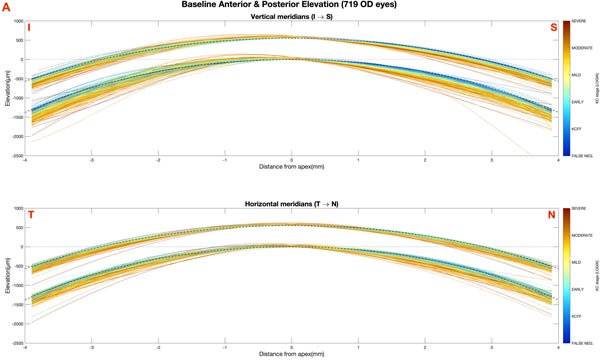
New article: Baseline findings in Retrospective Digital Computer Analysis of Keratoconus Evolution (REDCAKE) project
This work is the first of a series of papers to discuss the reults of the Retrospective Digital Computer Analysis of Keratoconus Evolution (REDCAKE), beginning with the baseline analysis for a large cohort of keratoconus patients. It looks at how the stage of the disease affects the cone curvature …
New article: Logistic index for keratoconus detection and severity scoring (Logik)
Knowing the stage of a keratoconic cornea is essential for progression follow-up and the choice of treatment. Proper staging can be challenging, however, since many of the available parameters are inadequate to the task (e.g. K_max and Pachy_min). This inspired us to develop the Logistic Index for…
New article: Computer aided diagnosis for suspect keratoconus detection
Our lab developed a new, stable and low-cost computer aided diagnosis system for early keratoconus detection. This system combines a custom-made mathematical model, a feedforward neural network and a Grossberg-Runge Kutta architecture to detect clinical and suspect keratoconus. It is able to detect…
New article: Average biometry of the cornea in a large population of Iranian school children
This work establishes the average Scheimpflug corneal tomography for a population of 4953 healthy Iranian primary school children. These data were transformed to determine the corneal position and orientation in three-dimensional space, followed by a model fit that combines a biconic with a Zernik…
New article: In vivo anterior scleral morphometry, axial length and myopia
This work reports on the relatively strong correlations between anterior scleral morphometry and axial length, and consequently to the refractive state of the eye in myopes and emmetropes. The refractive state of each patient should therefore be taken into consideration when analysing scleral …
New paper: Scleral asymmetry as a potential predictor for scleral lens compression
This study shows that scleral asymmetry can be used as a parameter to predict scleral lens settling. Larger amounts of scleral asymmetry were found to lead to larger decentration in the impression of the lens on the ocular surface, as well as deeper compression of the sclera. Scleral asymmetry has…
New paper: Rotation asymmetry of the human sclera
In order to characterize the mean topographical shape of the human sclera of a normal eye forty-five participants aged 19 to 45 years were measured with a corneo-scleral topographer (Eye Surface Profiler). For each 3D map, the sclera (maximum diameter of 16 mm) and cornea were automatically separa…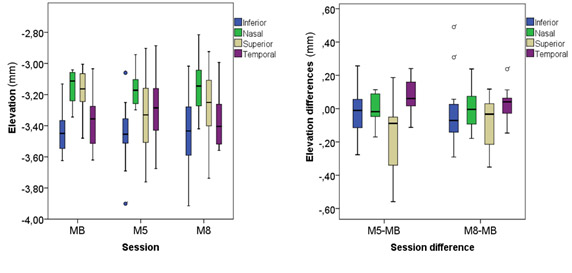
New paper: Anterior eye surface changes following miniscleral contact lens wear
The prescription of scleral contact lenses, as well as the number of practitioners who fit scleral contact lenses, has notably increased over the last few years. The purpose of this work was to quantify the effect of short-term miniscleral contact lens wear on the anterior eye surface of healthy ey…